

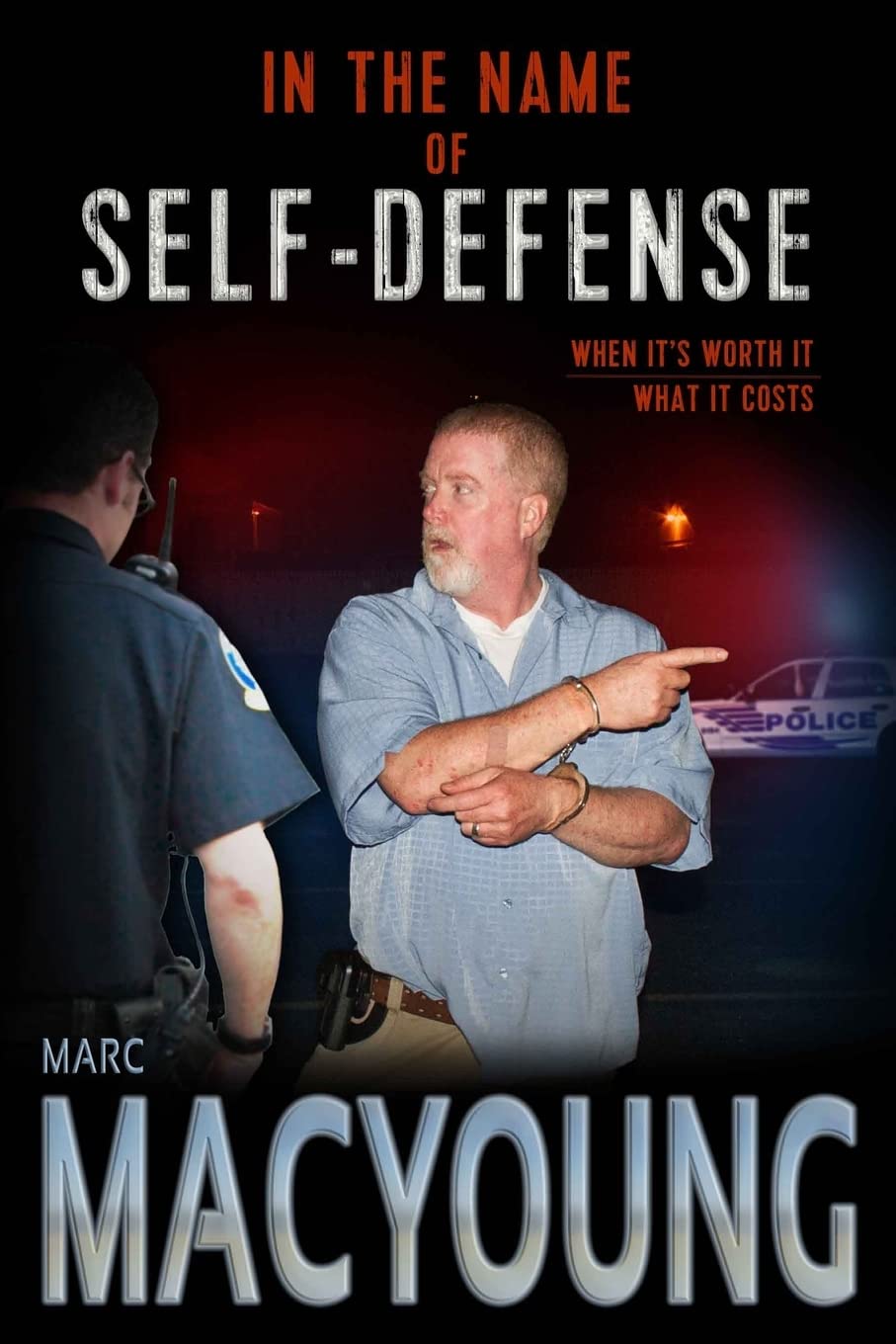
In the Name of Self-Defense: What it costs. When it's worth it Book by Marc MacYoung
The cell walls seem to close in as he buries his head in his hands. The same thoughts repeat over and over in his fogged mind: It all happened so quick. One second I was getting out of my car, the next he was attacking me. Now I'm being charged with manslaughter! How did this happen? It was self-defense . . . wasn’t it?
Prison is filled with people who thought they were defending themselves. Just saying, "It was self-defense" isn't enough. When you claim self-defense you are basically confessing to a crime. To keep from being convicted you must provide evidence your actions remained within certain boundaries and you acted with just cause. You're going to have to prove it was self-defense. That's assuming you stayed inside legal boundaries and acted reasonably in the first place. If you didn't . . .
Now . . . are you sure you know what constitutes actual self-defense? If the honest answer is no, then this book is an absolute must-read!
In the Name of Self-Defense is an in-depth exploration of what is and what is not self-defense. It covers real-life problems overlooked by most training—issues that will arise if you find yourself involved in violence. Most of all, it will challenge what you think you know about defending yourself.
Using the information contained in this book could mean the difference between legitimate self-defense, you laying in a parking lot, or prison!
This book presents information unlike any you've seen before, focusing not only on the aftermath of an incident, but on what commonly leads to violence and how your actions before, during, and after will make or break your claim of self-defense.
Learn about the limitations on self-defense, how to accurately assess a situation, scale force, and concisely “articulate” the timeline of events to officers and legal professionals in a manner that reduces the chances of a misunderstanding . . . and a subsequent prison sentence.
Whether you want to add to the knowledge you acquired as a beginner in a self-defense class, or you’re an instructor looking to further your own knowledge, or a professional whose job requirements place you in potentially violent situations with dissatisfied clients or customers . . . it doesn’t matter! In the Name of Self-Defense is a must-read for everybody!
If you're lucky, you will never need the information contained within these pages, but if you ever require it, what you learn from this volume will be vital.
Author and self-defense expert Marc MacYoung takes you on an entertaining journey through these lesser-known (and some never-before-broached) aspects of self-defense. MacYoung helps readers understand how to avoid violence, how to use the appropriate amount of force if it happens, and how to present the facts in a way that self-defense is clearly understood and judged applicable to that situation.
With a witty sense of humor and fifty years of experience in a plethora of violent encounters—coupled with a montage of experts in his corner—MacYoung delivers a thought-provoking examination of the world of self-defense and protecting yourself legally after being forced to protect yourself physically.
About the Author:
Marc MacYoung has never fit well into simple categories. That's because of his diverse past. When his family fell into situational poverty he found himself facing lifestyles and problems that most people have no idea exist, much less have experience dealing with. It was during that time the earned the street name "Animal." Many of his stories start with qualifiers like "The first time I was shot at..." and "The last time I had someone try to stab me..." (It was a long hard climb out of that lifestyle.) Decades of experience in environments and professions where violence was common, would eventually lead him to being a court recognized expert about violence, crime, and self-defense.
This wide ranging background gives him a completely different perspectives of the complex problems involved with personal safety, conflict, violence, and crime avoidance —especially how there are no simple answers (e.g., martial arts or carrying a gun). Those approaches may soothe fears, but they don't actually address danger —or the problems you'll face if you have to use them.
Over the years his works have evolved from that of a streetfighter to taking a more practical approach of avoidance and/or deterrence. This opens far more effective and non-violent options for his readers. As he often says "I'm not about fear management. My goal is danger management. I'm more interested in teaching you how to avoid walking into the lion's jaws than giving you false confidence about doing so."
Length: 482 pages
Publication date: 2014