

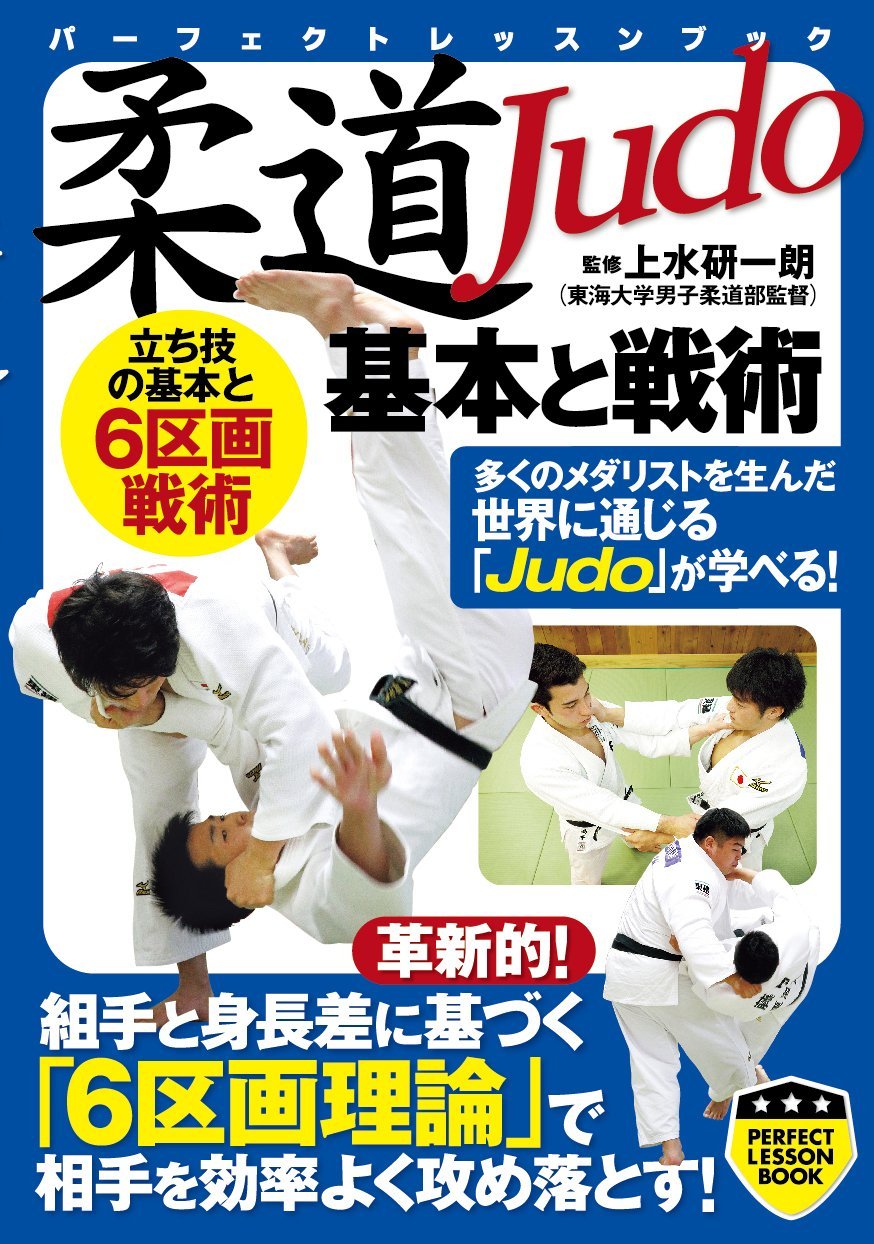
Judo: Fundamentals and Tactics Book by Kenichiro Agemizu
The innovative "Six-Zone Theory" that works on a global level, advocated by the coach of Tokai University Judo Club, which has produced many medalists.
Judo has now evolved into "JUDO" on a global scale, and in the 2016 Rio Olympics, medals were distributed among 26 countries across 14 weight classes for both men and women.
The idea that "since judo originated in Japan, Japanese athletes should be the strongest" is not entirely wrong, but it becomes incorrect when viewed from a different perspective.
Foreign athletes are utilizing and adapting their respective national martial arts within the rules, employing techniques and skills not seen in Japanese judo, and Japanese athletes are unable to cope with this phenomenon.
However, this does not mean that Japanese techniques are ineffective. This book re-examines Japanese judo techniques and organizes them around a "Six-Zone Theory" based on grappling and height differences, with the theme of how to compete against the world's strongest competitors.
In each zone, the basic techniques of grappling and the techniques to be utilized change.
In order to respond to various situations depending on the opponent, it is necessary to establish and organize one's own techniques within these six zones.
Table of Contents:
● Adapting to the Changing "Judo"
● Characteristics of Judo
What you gain from Judo (Mental aspects, Physical aspects) / Things to do in childhood /
Basic exercises (Leg splits, Seal pose, Bridge, Handstand, Human chain, etc.)
● Judo 6-Section Theory
How to adapt to the 6 sections? / Let's learn the "BIG 6" / Ai-yotsu and Kenka-yotsu /
Basic techniques and usage of the pulling hand / Changing the position of the gripping hand depending on the opponent's height /
Square box and rhombus box / Importance of the gripping hand's wrist / Adjusting the gripping hand / Sashikumi-te / Okukeri
・Section B / Ouchi Gari, Osoto Gari (vertical wrist), Osoto Gari (horizontal wrist), Seoi Nage, Harai Goshi, Osoto Gari to Sasae Tsurikomi Ashi
・Section A / Ouchi Gari, Ouchi Gari (rear belt), Kouchi Gari to Ouchi Gari, Seoi Nage, Seoi Nage to Kouchi Gari
・Section C / Harai Goshi, Harai Goshi to Sasae Tsurikomi Ashi, Kosoto Gari to Harai Goshi, Osoto Gari, Osoto Gari to Sasae Tsurikomi Ashi,
Osoto Gari to Kouchi Gari
・Section E / Tai Otoshi (gripping hand down), Tai Otoshi (gripping hand up), Uchi Mata (gripping hand down), Uchi Mata (gripping hand up),
Ippon Seoi Nage (gripping hand down), Ippon Seoi Nage (gripping hand up)
・Section D / Tai Otoshi, Ouchi Gari (diagonal), Ouchi Gari to Tai Otoshi, Ouchi Gari to Ashi Barai, Seoi Nage,
Seoi Nage to Kouchi Gari, Ippon Seoi Nage (gripping hand down), Ippon Seoi Nage (gripping hand up), Ippon Seoi Nage to Kouchi Gari
・Section F / Harai Goshi, Kosoto Gari to Harai Goshi, Uchi Mata (gripping hand up), Uchi Mata to Kosoto Gari, Uchi Mata to Kouchi Gari
Language: Japanese
Length: 192 pages
Publication date: 2017
Couldn't load pickup availability